
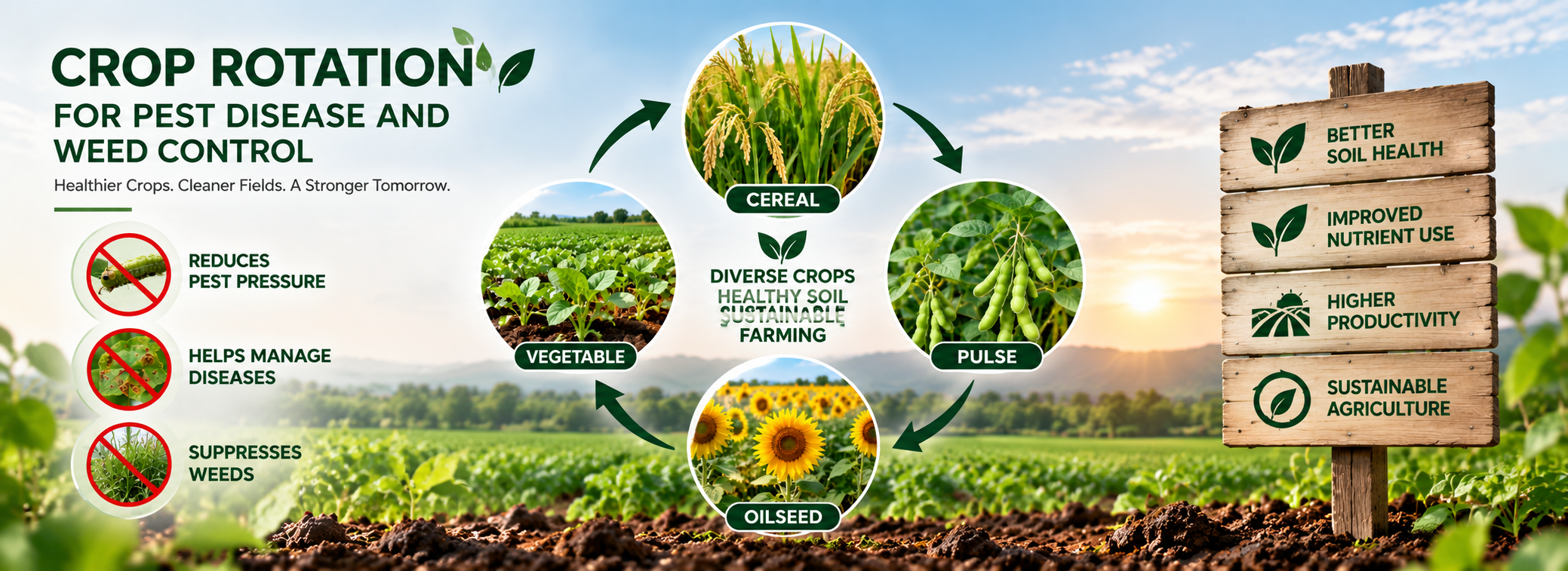
Crop rotation for pest disease and weed control is one of the most practical agricultural practices for reducing repeated pest pressure, limiting certain crop diseases and managing troublesome weeds.
Crop rotation means growing different crops on the same field in a planned sequence instead of planting the same crop or closely related crops season after season.
Changing the crop changes the biological and physical conditions in the field. This can interrupt the life cycles of crop-specific pests, reduce the buildup of some soil- and residue-borne pathogens, change weed-growing conditions and improve overall soil management.
However, crop rotation works best as part of an Integrated Pest Management (IPM) and crop-management programme rather than as a standalone solution.
Quick Answer: How Does Crop Rotation Help?
Crop rotation helps agriculture by replacing a pest or pathogen’s preferred host with a different crop.
A properly designed crop rotation may help:
- Break certain insect pest life cycles.
- Reduce the buildup of specific crop diseases.
- Disturb weed germination and reproduction patterns.
- Reduce repeated reliance on the same herbicide programme.
- Improve nutrient management.
- Support better soil structure.
- Diversify farm production.
- Strengthen integrated crop-protection strategies.
The effectiveness of rotation depends on the crop, pest or disease involved, field history, climate and duration of the rotation.
What Is Crop Rotation in Agriculture?
Crop rotation in agriculture is the planned cultivation of different crops on the same land over consecutive seasons or years.
For example, a farmer may grow:
Cereal → Pulse → Oilseed → Suitable Commercial Crop
The most effective sequence varies according to the region, soil type, available irrigation, cropping season and farm objective.
Crop rotation should therefore be designed strategically rather than simply replacing one crop with another.
A good crop-rotation plan considers:
- Crop family.
- Rooting depth.
- Nutrient requirements.
- Planting season.
- Harvesting period.
- Irrigation availability.
- Pest history.
- Disease history.
- Weed pressure.
- Soil condition.
- Climate.
- Market requirements.
Rotating between unrelated botanical families is particularly useful because closely related crops may host many of the same pests and pathogens.
How Does Crop Rotation Help Control Agricultural Pests?
Crop rotation for pest control works mainly by removing or reducing the availability of a pest’s preferred host.
Many agricultural insects and other pests rely on a particular crop or crop family for feeding, reproduction or survival.
When the same crop is planted continuously, pests adapted to that crop may find a reliable food and breeding source every season.
Replacing that crop with a suitable non-host crop can interrupt this pattern.
Crop Rotation Can Break Pest Life Cycles
Suppose a pest survives in the soil or crop residue and depends strongly on one crop family.
If the same host crop is planted again, the emerging pest can quickly find a suitable plant.
When an unrelated non-host crop is planted instead, the pest may be unable to complete its normal life cycle successfully.
Over time, this can reduce pest pressure.
Crop rotation is generally more useful against pests that:
- Have a relatively narrow host range.
- Survive in crop residue or soil.
- Remain mainly within the same field.
- Depend strongly on one crop family.
- Have limited ability to migrate between farms.
When Is Crop Rotation Less Effective for Pest Control?
Crop rotation may provide limited control against pests that:
- Fly long distances.
- Have a very wide host range.
- Reproduce on several crop families.
- Move rapidly from nearby fields.
- Survive on weeds or volunteer plants.
For this reason, crop rotation should be combined with crop scouting, field sanitation, healthy planting material, resistant varieties where available and need-based crop-protection measures.
How Does Crop Rotation Help Reduce Crop Diseases?
Crop rotation for disease management can be especially useful against certain pathogens that remain in soil, roots or infected crop residues.
When susceptible crops are planted continuously, some pathogens can gradually increase within the field.
Rotating to a crop that the pathogen cannot infect removes its preferred host for a period of time.
Breaking the Crop Disease Cycle
Certain fungi, bacteria and plant-parasitic nematodes may survive between growing seasons in:
- Soil.
- Infected plant material.
- Crop residues.
- Roots.
- Volunteer plants.
If the same susceptible crop is planted repeatedly, the disease cycle may continue.
Introducing a suitable non-host crop may help reduce the amount of viable pathogen material present before the susceptible crop is grown again.
When Is Crop Rotation Most Effective Against Disease?
Crop rotation is generally more effective when:
- The pathogen has a narrow host range.
- The disease survives mainly in crop residue or soil.
- Crops from the same family are not planted consecutively.
- Volunteer host plants are properly controlled.
- Diseased crop residue is managed appropriately.
- The rotation is long enough for the target pathogen.
- Healthy planting material is used.
The required rotation period may vary considerably between diseases.
Some crop problems may respond to a one- or two-season break, while other pathogens may survive for considerably longer periods.
Can Crop Rotation Prevent All Plant Diseases?
No.
Crop rotation cannot completely prevent every plant disease.
Some diseases may spread through:
- Wind.
- Contaminated seed.
- Irrigation water.
- Farm equipment.
- Insects.
- Nearby infected plants.
- Alternative host plants.
Therefore, disease management should also include field monitoring, sanitation, suitable varieties, balanced crop nutrition and approved crop-protection practices where required.
How Does Crop Rotation Help Control Weeds?
Crop rotation for weed control works differently from pest and disease rotation.
When one crop is grown repeatedly, farmers often use similar sowing dates, tillage practices, irrigation schedules, crop spacing and herbicide programmes.
This creates a relatively predictable environment.
Over time, weed species adapted to these conditions may become increasingly dominant.
Crop Rotation Changes Weed-Growing Conditions
Different crops have different:
- Planting dates.
- Harvesting periods.
- Canopy structures.
- Row spacing.
- Irrigation requirements.
- Nutrient demands.
- Tillage practices.
- Weed-control options.
Changing these conditions can interrupt weed germination, establishment and seed production.
For example, a dense and rapidly growing crop may create greater competition for sunlight, moisture and nutrients than a widely spaced crop.
Changing the sowing season may also affect weeds that typically emerge during a particular period.
How Crop Rotation Supports Better Weed Management
Crop rotation may help weed management by:
- Changing sowing and harvesting periods.
- Varying tillage operations.
- Introducing crops with better canopy coverage.
- Interrupting weed seed production.
- Changing irrigation schedules.
- Preventing one weed species from dominating.
- Allowing different mechanical control techniques.
- Creating more opportunities to vary herbicide programmes.
A diversified cropping system is particularly valuable because weed management should not depend repeatedly on one control method.
Crop Rotation and Herbicide Resistance
Repeated use of herbicides with the same mode of action can increase selection pressure on weed populations.
Over time, resistant weeds may become more difficult to manage.
Crop rotation makes it easier to vary agronomic practices and combine:
- Cultural weed control.
- Mechanical weed control.
- Crop competition.
- Appropriate herbicide programmes.
- Different planting and harvesting schedules.
The goal should be diversified weed management rather than simply replacing one herbicide with another.
What Are the Major Benefits of Crop Rotation?
The benefits of crop rotation extend beyond pest, disease and weed control.
1. Better Nutrient Management
Different crops require different nutrients and obtain them from different soil depths.
A diversified rotation can therefore help reduce continuous pressure on the same nutrient resources.
Leguminous crops may also contribute biologically fixed nitrogen to the farming system under suitable conditions.
2. Improved Soil Structure
Different root systems interact with the soil differently.
Alternating shallow-rooted and deeper-rooted crops may support better:
- Soil structure.
- Root-zone development.
- Water movement.
- Soil aeration.
- Residue diversity.
Crop residues can also contribute organic material when managed appropriately.
3. Improved Crop Diversity
Growing more than one crop reduces complete dependence on a single production system.
Diversification may help distribute:
- Labour requirements.
- Irrigation demand.
- Input costs.
- Production risk.
- Market exposure.
4. Reduced Biological Pressure
When the same crop is repeatedly cultivated, crop-specific biological problems may become more persistent.
Rotation changes the field environment and can make conditions less favourable for some pests, pathogens and weeds.
5. Stronger Integrated Pest Management
Crop rotation is an important cultural component of Integrated Pest Management.
It can reduce initial pest or disease pressure before additional control measures become necessary.
This may allow crop-protection decisions to be based more effectively on field monitoring and actual crop conditions.
Crop Rotation vs Continuous Cropping
| Crop Rotation | Continuous Cropping |
|---|---|
| Different crops grown in sequence | Same or closely related crop repeatedly grown |
| Can interrupt certain pest cycles | May maintain host availability |
| Helps diversify weed-management practices | Similar weeds may be repeatedly favoured |
| May reduce certain disease buildup | Some pathogens may accumulate |
| Diversifies rooting and nutrient demand | Similar nutrient demand each season |
| Supports IPM programmes | May increase dependence on repeated control practices |
Continuous cropping does not automatically lead to crop failure, but it can increase management challenges when crop-specific biological problems become established.
How to Plan an Effective Crop Rotation
There is no single crop-rotation sequence that works for every farm.
A successful programme should be based on field history, crop biology and local growing conditions.
Step 1: Review the Field History
Record the crops grown during previous seasons.
Also document:
- Major pests.
- Recurring diseases.
- Weed problems.
- Previous herbicides.
- Irrigation issues.
- Crop performance.
Step 2: Identify the Main Problem
Determine whether the rotation is primarily intended to manage:
- A particular insect.
- Soil-borne disease.
- Nematodes.
- Weed pressure.
- Nutrient imbalance.
- Soil structure.
- Multiple problems.
This determines which crop should follow.
Step 3: Rotate Crop Families
Where practical, avoid repeatedly growing closely related crops.
Crops within the same botanical family may share pests and diseases.
Introducing an unrelated crop provides a stronger biological break.
Step 4: Vary Rooting Patterns
Combining crops with different root depths can diversify nutrient uptake and soil exploration.
Step 5: Include Different Crop Types
Depending on local suitability, a rotation may include:
- Cereals.
- Pulses.
- Oilseeds.
- Vegetables.
- Commercial crops.
- Suitable cover crops.
Step 6: Consider Water Availability
The ideal crop sequence should match available irrigation and rainfall.
Choosing a crop without considering water demand can create unnecessary stress and reduce the benefits of rotation.
Step 7: Control Volunteer Plants
Plants left from a previous crop may act as alternative hosts for pests and diseases.
Controlling volunteer crops helps create a more effective host break.
Step 8: Monitor and Adjust
Crop rotation is not a fixed programme.
Record crop performance and modify future rotations according to field observations.
Example of a Crop Rotation Strategy
A simplified rotation might look like:
Cereal → Pulse → Oilseed → Cereal
However, this is only an example.
The appropriate crop sequence should depend on:
- Location.
- Soil type.
- Climate.
- Irrigation.
- Target pest or disease.
- Crop profitability.
- Available markets.
Farmers should avoid adopting a generic rotation without considering local agronomic conditions.
Is Crop Rotation Part of Sustainable Agriculture?
Yes. Crop rotation is widely used as part of sustainable crop management because it diversifies the farming system and reduces repeated biological pressure.
It can support:
- Integrated pest management.
- Integrated weed management.
- Soil-health management.
- Nutrient-use planning.
- Crop diversification.
- Long-term field productivity.
However, sustainable farming does not depend on crop rotation alone.
Irrigation, soil fertility, crop protection, seed quality and field monitoring must also be managed effectively.
Frequently Asked Questions About Crop Rotation
How does crop rotation control pests?
Crop rotation controls certain pests by replacing their preferred host crop with a non-host crop. This interrupts feeding and reproduction and may reduce pest populations over time.
How does crop rotation control crop diseases?
Crop rotation can reduce some soil- and residue-borne diseases by removing the susceptible host crop for one or more seasons. It works best against pathogens with a limited host range.
How does crop rotation help control weeds?
Different crops change planting dates, canopy coverage, irrigation, tillage and weed-control practices. These changes make it harder for the same weed species to dominate repeatedly.
Can crop rotation completely eliminate pests?
No. Crop rotation can reduce certain pest populations but will not eliminate every pest. Highly mobile insects and pests with multiple host plants may still require additional management.
Can crop rotation prevent all crop diseases?
No. Rotation is most effective against certain soil- and residue-borne diseases. Diseases spread by wind, water, infected seed or insect vectors may still occur.
How long should a crop rotation be?
There is no universal duration. The required rotation depends on the crop, pathogen or pest, field history and local growing conditions. Some crop-protection problems require rotations extending across several seasons.
Can crops from the same family be grown in rotation?
They can be grown sequentially, but closely related crops often share pests and diseases. Rotating with an unrelated crop usually provides a stronger biological break.
Which crop is best for crop rotation?
There is no single best rotational crop. The choice should depend on soil conditions, water availability, previous crop, target pest or disease, climate and local market requirements.
Conclusion
Crop rotation for pest disease and weed control is an important cultural practice for building a more resilient agricultural production system.
By changing crop hosts and field conditions, a well-planned rotation can help interrupt certain pest life cycles, reduce the buildup of some crop diseases, suppress weed dominance and diversify crop-management practices.
Crop rotation can also support nutrient management, soil structure and integrated crop protection.
For the best results, crop rotation should be planned according to crop family, field history, soil, water availability, target pests and diseases, local climate and commercial requirements.
It should also be combined with field monitoring, balanced nutrition, suitable irrigation, healthy planting material and responsible crop-protection practices.
Agricultural Crop Protection Support from Agrivo Chemicals
Agrivo Chemicals Private Limited provides agricultural crop-care and crop-protection solutions for farmers, dealers, distributors and agricultural businesses.
For information about crop-management solutions or agricultural product requirements, contact the Agrivo Chemicals team.
Call: +91 97635 55529
Email: info@agrivochemicals.com
Address: Uttam Warehousing, 9/1, Near Poonam Petrol Pump, Mangdewadi, Katraj, Pune, Maharashtra 411046
Website: www.agrivochemicals.com