
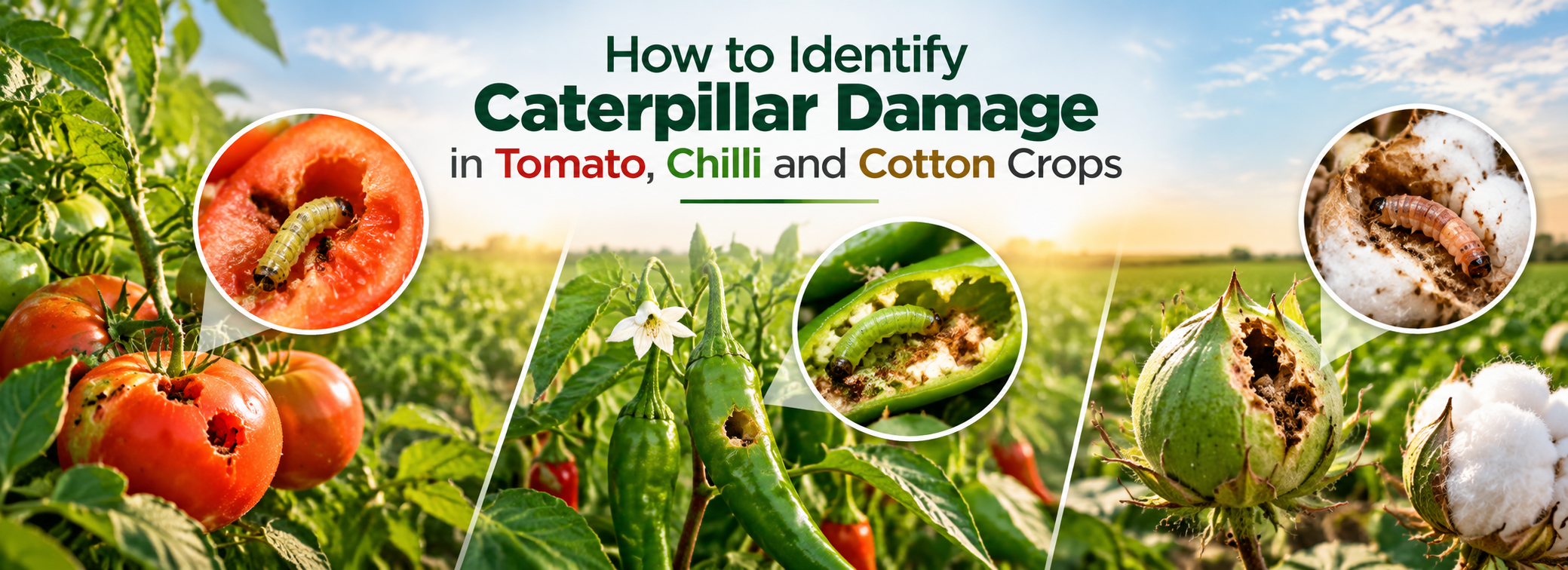
Caterpillar damage in tomato, chilli and cotton crops can develop quickly, but the first signs are not always obvious. A farmer may initially notice a small hole in a fruit, damaged flower buds, partially eaten leaves, dark droppings near the feeding area, or an apparently healthy cotton boll that shows damage only after it is opened.
Identifying the damage correctly is important because different caterpillar pests attack different plant parts and do not always create the same symptoms. Some feed openly on leaves, while others enter tomato or chilli fruits, cotton squares or bolls. Certain larvae, such as the tomato leaf miner, may even remain hidden inside leaf tissue.
The most useful first step is therefore not simply asking, “Which pesticide should I use?” Instead, examine the crop carefully and determine:
- Which plant part is damaged?
- Is the damage fresh or old?
- Are larvae, eggs or droppings visible?
- Is the pest feeding outside or inside the plant tissue?
- How many plants are affected?
- Is the infestation limited to one part of the field or spreading?
- Could another insect, disease or physiological problem be producing similar symptoms?
Correct identification helps farmers choose a more crop-specific and pest-specific management strategy instead of treating every hole or damaged leaf in the same way.
This guide explains how to identify caterpillar damage in tomato, chilli and cotton crops, which plant parts to inspect, what common feeding symptoms look like and what to check before deciding on a control method.
Quick Answer: What Does Caterpillar Damage Look Like?
Caterpillars generally damage crops by chewing plant tissue.
Common symptoms may include:
- Irregular holes in leaves
- Scraped or partially eaten leaf tissue
- Damaged buds and flowers
- Holes in tomato or chilli fruits
- Holes or feeding damage in cotton squares and bolls
- Internal feeding inside fruits or bolls
- Dark granular droppings, known as frass
- Shed buds or damaged reproductive structures
- Leaf mines or galleries caused by larvae feeding inside leaf tissue
- Larvae hiding inside damaged plant parts
However, a hole alone does not confirm an active caterpillar infestation.
A fruit may have been damaged several days earlier. The larva may already have moved to another plant part, completed its feeding stage or disappeared. Similarly, symptoms caused by borers, leaf miners, sucking pests, diseases or mechanical injury can sometimes be confused with caterpillar damage.
This is why farmers should inspect the plant, identify fresh feeding signs and confirm the likely pest before choosing a treatment.
Why Early Identification of Caterpillar Damage Matters
Caterpillar pests can affect both vegetative and reproductive parts of crops.
Damage to leaves can reduce the functional leaf area available to the plant, while feeding on flowers, fruits, squares or bolls can directly affect the marketable portion of the crop.
In tomato and chilli, a damaged fruit may become unsuitable for sale even if the rest of the plant looks healthy.
In cotton, damage inside developing bolls may not always be obvious from a quick visual inspection. Internal feeding can affect boll development and fibre quality, which makes systematic field monitoring important.
Early identification also helps distinguish between:
- An isolated damaged fruit
- A low-level pest presence
- An active and expanding infestation
- Old damage where the pest is no longer present
- Damage caused by another pest altogether
This distinction matters because pest management should be based on current field conditions rather than on one damaged leaf or fruit.
Integrated Pest Management, or IPM, emphasizes monitoring, correct pest identification and the use of suitable biological, cultural, physical and chemical tools rather than relying automatically on pesticide application. FAO describes IPM as the careful integration of available pest-management techniques while minimizing unnecessary pesticide use and associated risks.
Common Signs of Caterpillar Damage in Crops
Although symptoms vary by pest and crop, several signs deserve attention during field scouting.
1. Irregular Holes in Leaves
Leaf-feeding caterpillars often chew through the leaf surface and create holes with uneven edges.
Fresh damage may appear lighter or greener around the feeding area, while older damage may become dry or brown.
Check both the upper and lower surfaces of leaves because larvae may remain hidden underneath foliage during certain parts of the day.
2. Skeletonised or Scraped Leaves
Some young larvae initially scrape the surface of the leaf rather than making large holes.
As feeding increases, larger sections of the leaf can disappear.
Do not judge pest severity only by the size of one damaged leaf. Compare several plants and determine whether fresh feeding is continuing.
3. Damaged Buds and Flowers
Many caterpillar pests prefer tender reproductive structures.
Look for:
- Bored flower buds
- Partially eaten flowers
- Dropped buds
- Damaged cotton squares
- Frass near the damaged area
- Larvae hiding between petals or plant folds
Damage to reproductive structures deserves particular attention because it can directly affect fruit or boll formation.
4. Holes in Fruits or Bolls
Tomato, chilli and cotton pests may bore into reproductive structures.
The outside may show:
- A small circular or irregular opening
- Dark material around the hole
- Dried tissue surrounding the entry point
- Frass
- Premature rotting in fruits
- Discoloration around damaged tissue
The external opening may underestimate the amount of damage occurring inside.
5. Frass Around Feeding Sites
Frass is insect waste produced during feeding.
It often appears as small dark or brownish particles near:
- Fruit entry holes
- Buds
- Flowers
- Leaf folds
- Cotton bolls
- Other feeding sites
Frass is one of the useful clues when trying to determine whether a hole has been produced by a chewing larva.
However, it should still be considered together with other evidence.
6. Internal Feeding
One of the most important inspection techniques is carefully opening a few damaged samples.
Cut open affected:
- Tomatoes
- Chillies
- Cotton bolls
Look for:
- A living larva
- Feeding tunnels
- Damaged seeds or internal tissues
- Frass
- Rot associated with the feeding wound
- Signs that the larva has already exited
Internal feeding can explain why apparently minor external symptoms sometimes correspond to substantial crop damage.
How to Identify Caterpillar Damage in Tomato Crops
Tomato plants can be attacked by different caterpillar and larval pests, and symptoms vary according to where the insect feeds.
For caterpillar and borer management enquiries in crops such as tomato, chilli and cotton, farmers can also explore AGRIVO EMA CORA
When examining tomato crops, inspect three major areas separately:
- Leaves
- Flowers and buds
- Fruits
Signs of Caterpillar Damage on Tomato Fruits
Tomato fruit damage is often one of the easiest symptoms for farmers to notice.
Check both green and ripening fruits for:
- Small or large entry holes
- Feeding near the fruit shoulder or stem end
- Frass near the opening
- Damaged or softened tissue
- Internal cavities
- Larvae inside the fruit
- Secondary rotting around the damaged area
Do not inspect only fruits that have already ripened.
Green tomatoes may reveal fresh feeding earlier and can help determine whether the infestation is still active.
Open a Few Damaged Tomatoes
Where appropriate, cut open a sample of affected fruits.
A caterpillar may have entered through a relatively small opening but consumed considerably more tissue inside.
Compare:
- Freshly damaged fruit
- Older damaged fruit
- Apparently healthy fruit from the same area
This gives a clearer picture of current pest activity.
Caterpillar Damage on Tomato Leaves
Not all tomato larvae create obvious holes.
Some pests feed inside the leaf.
One important example is tomato leaf miner, Tuta absoluta.
ICAR reports that Tuta absoluta larvae can damage tomato leaves, stems, buds, calyces and fruits. Feeding inside leaves produces characteristic mined galleries, and larvae may be found within those galleries.
Look for:
- Pale, whitish or translucent patches
- Irregular mines within leaf tissue
- Brown or dried mined areas
- Larvae visible inside a mine
- Damaged buds
- Fruit injury occurring along with leaf mines
A mined tomato leaf should not automatically be treated as ordinary leaf-chewing damage.
Examine the feeding pattern closely.
Fruit Borer Damage vs Leaf Miner Damage in Tomato
Farmers may describe both problems simply as “caterpillar damage,” but their symptoms can differ.
Fruit-boring type damage may show:
- Entry hole in tomato fruit
- Frass near the hole
- Larva feeding directly in or around fruit
- Damaged buds or flowers in some cases
Leaf-miner type damage may show:
- Tunnels or blotches inside leaf tissue
- Little obvious external chewing during early stages
- Larvae protected within the leaf
- Damage extending to buds or fruit depending on the pest
Correctly identifying the feeding pattern can prevent the wrong pest-management decision.
Where Should You Inspect a Tomato Plant?
A practical inspection sequence is:
Top growth: Check tender new leaves and buds.
Middle canopy: Turn leaves over and check both surfaces.
Flowers: Look for feeding, webbing, frass or larvae.
Fruit clusters: Examine green and ripening fruits.
Damaged fruit: Open a few samples.
Nearby plants: Determine whether the symptoms repeat.
Do not base a field decision on one tomato plant alone.
How to Identify Caterpillar Damage in Chilli Crops
Chilli plants can show several types of insect damage, making correct identification especially important.AGRIVO’s LANKESH insecticide page also lists chilli, tomato and cotton among its recommended crops.
Begin by inspecting:
- New growth
- Leaves
- Flower buds
- Flowers
- Developing chillies
- Mature chillies
Signs of Caterpillar Damage on Chilli Fruits
Look for:
- Small holes in developing chillies
- Larger irregular openings
- Frass around an entry point
- Feeding inside the chilli
- Damaged seeds or internal tissue
- Premature fruit deterioration
- Larvae hiding within damaged fruit
Cut open a few affected chillies to determine whether the damage remains on the surface or extends internally.
A tiny external hole may lead to a larger feeding cavity inside.
Check Chilli Flowers and Buds
Some caterpillar pests may attack reproductive parts before obvious fruit damage appears.
Look for:
- Damaged flower buds
- Chewed petals
- Aborted flowers
- Frass
- Larvae around flowers
- Feeding on very small developing chillies
If fruit damage suddenly appears, checking nearby flowers and new fruit can help determine whether the infestation is still developing.
Does Leaf Curling Mean Caterpillar Damage in Chilli?
No. Leaf curling alone does not confirm caterpillar damage.
Chilli leaf curling can be associated with several possible causes, including:
- Sucking pests
- Mites
- Viral infection
- Nutritional imbalance
- Environmental stress
- Other crop-health problems
Therefore, do not assume that curled chilli leaves require a caterpillar-control product.
Instead:
- Inspect the underside of leaves.
- Look for visible insects.
- Check whether leaf tissue has actually been eaten.
- Examine new growth.
- Look for fruit and flower damage.
- Take clear photographs.
- Seek expert diagnosis if symptoms remain unclear.
The presence of a specific symptom is useful evidence, but it is not always a complete diagnosis.
How to Inspect Chilli Crops for Caterpillars
Walk through several parts of the field instead of checking only the outer rows.
At each sample location, inspect:
- Young leaves
- Leaf undersides
- Buds
- Open flowers
- Small fruits
- Larger fruits
- Damaged chillies
Record whether the damage is:
- Fresh
- Old
- Scattered
- Clustered
- Increasing
This helps distinguish an active pest problem from isolated previous damage.
How to Identify Caterpillar Damage in Cotton Crops
Cotton requires careful inspection because several important pests attack reproductive structures.
When checking for caterpillar or bollworm damage, pay particular attention to:
- Squares
- Flowers
- Small bolls
- Green bolls
- Mature bolls
What Are Cotton Squares?
Cotton squares are the flower buds that develop before flowering.
Because they eventually form flowers and bolls, damage to squares can affect the reproductive potential of the crop.
During scouting, look for:
- Holes in squares
- Chewed tissue
- Frass
- Abnormal or damaged buds
- Prematurely shed squares
- Larvae around the damaged structure
One fallen square does not automatically indicate a serious caterpillar infestation, so inspect multiple plants before drawing conclusions.
Signs of Bollworm Damage in Cotton
Possible signs include:
- Entry holes in green bolls
- Damaged squares
- Damaged flowers
- Internal feeding
- Frass
- Damaged seeds
- Discoloration inside the boll
- Larvae within sampled bolls
The outside of a boll may sometimes show only a small mark.
Opening selected bolls can therefore provide more useful information than external observation alone.
Pink Bollworm: Why Internal Inspection Is Important
Pink bollworm can be difficult to identify using only surface symptoms because larvae feed within reproductive structures.
ICAR-Central Institute for Cotton Research has emphasized monitoring with pheromone traps and destructive sampling of green bolls for detecting pink bollworm incidence and supporting field-management decisions.
This means farmers should not rely only on obvious external boll damage.
Where pink bollworm is suspected:
- Inspect green bolls
- Open a representative sample
- Check internal tissue and seeds
- Record larvae if present
- Observe moth activity through appropriate monitoring systems
- Seek locally applicable recommendations
Monitoring becomes especially important when the crop reaches susceptible reproductive stages.
What Is the Best Way to Scout a Cotton Field?
Avoid checking only one corner.
A better approach is to walk through different sections of the field in a structured pattern.
For example:
- Begin near one field edge.
- Move toward the centre.
- Inspect plants at multiple intervals.
- Check squares, flowers and bolls.
- Open selected damaged green bolls.
- Record how frequently damage occurs.
- Compare observations from different field sections.
The purpose is not simply to find one insect.
The purpose is to understand how widespread and active the infestation is.
Fresh Damage vs Old Caterpillar Damage
One of the most common mistakes in crop scouting is treating old damage as proof that the pest is still active.
Signs that damage may be relatively fresh include:
- Moist or recently chewed tissue
- Fresh frass
- A live larva nearby
- Recently damaged buds or fruits
- Similar new symptoms on multiple plants
Older damage may show:
- Dry, hardened wound edges
- No fresh frass
- No larva
- Dried fruit tissue
- Healed or dried leaf damage
This difference matters when deciding whether immediate control is necessary.
Caterpillar Damage vs Other Crop Problems
Not every damaged crop has a caterpillar problem.
Farmers should compare symptoms before choosing a crop-protection product.
Caterpillars typically produce:
- Chewing damage
- Missing plant tissue
- Entry holes
- Frass
- Visible larvae or internal feeding
Sucking pests may produce:
- Curling
- Yellowing
- Stunting
- Sticky secretions
- Fine spotting
Diseases may produce:
- Circular or irregular lesions
- Rot
- Wilting
- Blighting
- Fungal growth
- Characteristic discoloration
Nutritional or physiological problems may produce:
- Uniform chlorosis
- Marginal burning
- Blossom-end disorders
- Abnormal growth without chewing
When symptoms overlap, professional diagnosis becomes valuable.
A 7-Step Field Checklist for Caterpillar Damage
Step 1: Identify the Damaged Plant Part
Ask:
Is the damage occurring on:
- Leaves?
- Buds?
- Flowers?
- Tomato fruits?
- Chilli fruits?
- Cotton squares?
- Cotton bolls?
The damaged plant part can immediately narrow the list of likely pests.
Step 2: Look for Fresh Feeding
Check whether the tissue appears recently eaten.
Search for:
- Freshly chewed margins
- New entry holes
- Frass
- Larvae
- Damaged neighbouring plant parts
Step 3: Inspect Hidden Areas
Caterpillars frequently remain concealed.
Check:
- Leaf undersides
- Folded leaves
- Flowers
- Fruit clusters
- Inside damaged tomatoes
- Inside damaged chillies
- Inside cotton bolls
Step 4: Inspect Multiple Plants
Do not make a spray decision from one plant.
Walk through multiple field areas and determine:
- How many plants show damage
- Which crop stage is affected
- Whether symptoms are concentrated
- Whether the damage is increasing
Step 5: Photograph the Pest and Damage
Take separate photographs of:
- Whole plant
- Damaged plant part
- Entry hole or mine
- Frass
- Larva
- Internal damage after opening a fruit or boll
Include an object for scale when possible.
Clear images can help an agronomist distinguish similar pest problems more accurately.
Step 6: Record Basic Field Information
Write down:
- Crop
- Variety or hybrid, if known
- Crop age or growth stage
- Date
- Village or location
- Recent weather conditions
- Plant part affected
- Estimated number of affected plants
- Products recently applied
- Photographs of symptoms
This information makes remote or local diagnosis more useful.
Step 7: Confirm Before Selecting a Product
Where the pest is uncertain, contact:
- A qualified agronomist
- Agricultural extension officer
- Krishi Vigyan Kendra
- Crop adviser
- Qualified crop-protection specialist
Correct diagnosis should come before product selection.
Should You Spray as Soon as You See Caterpillar Damage?
Not necessarily.
Seeing one damaged tomato, chilli or cotton boll does not automatically indicate that an immediate pesticide application is required.
First determine:
- Is the pest still present?
- Is the damage fresh?
- How widespread is the infestation?
- What is the crop stage?
- Which caterpillar species is likely responsible?
- Are local economic or action thresholds available?
- Are biological or other IPM measures appropriate?
- Is a crop-protection product approved for the crop and pest?
FAO’s IPM framework recommends considering available management options and monitoring pest populations before relying on chemical controls.
What Should You Check Before Choosing a Caterpillar-Control Product?
Before selecting any crop-protection product, confirm:
Crop
A product suitable for cotton may not automatically be suitable for chilli or tomato.
Target Pest
Different caterpillar species may respond differently to different management strategies.
Crop Stage
Young plants, flowering crops and crops close to harvest can require different considerations.
Product Registration and Label
Use only products legally approved and labelled for the intended crop and target pest in your location.
Recommended Dose
Never assume that increasing the dose will improve control.
Follow label instructions exactly.
Application Timing
Pest stage and feeding location can affect treatment performance.
Pre-Harvest Interval
For food crops such as tomato and chilli, observe the product’s stated waiting period before harvest.
Application Safety
Use recommended protective equipment, handling practices and disposal procedures.
Local Recommendations
Pest pressure, resistance patterns, crop conditions and approved uses can differ by region.
Always prioritize current local agricultural guidance.
Role of Integrated Pest Management in Caterpillar Control
Effective caterpillar management is broader than spraying.
An Integrated Pest Management (IPM) programme may combine:
- Regular scouting
- Pest identification
- Field sanitation
- Removal of severely affected plant material where locally recommended
- Pheromone or other monitoring traps
- Conservation of beneficial organisms
- Biological-control options
- Crop-specific cultural practices
- Threshold-based decision-making
- Selective use of approved crop-protection products when justified
FAO defines IPM as an ecosystem-oriented approach that integrates different management methods while aiming to keep pest populations at acceptable levels and reduce unnecessary pesticide dependence.
The exact combination will vary by crop, pest, location and growing season.
Why Pest Identification Is Important Before Spraying
Incorrect diagnosis can lead to several problems.
A farmer may:
- Apply a caterpillar product where a sucking pest is actually present
- Treat old damage when the active larva has already disappeared
- Use the wrong product for a leaf miner
- Miss internal boll infestation
- Repeat applications unnecessarily
- Overlook another disease or pest
This is why crop scouting should answer three questions before control measures are chosen:
What is causing the damage?
Is the pest currently active?
Is the infestation significant enough to require intervention?
Crop-Wise Caterpillar Damage Comparison
| Crop | Plant Parts to Inspect | Common Warning Signs | Important Check |
|---|---|---|---|
| Tomato | Leaves, buds, flowers, green and ripe fruit | Leaf holes, mines, fruit entry holes, frass, internal feeding | Check whether damage is from an external fruit feeder or a leaf-mining larva |
| Chilli | Leaves, buds, flowers, developing and mature fruits | Fruit holes, flower damage, frass, internal feeding | Do not assume leaf curl alone means caterpillar damage |
| Cotton | Squares, flowers and bolls | Damaged squares, boll holes, internal feeding, frass | Open sampled green bolls and monitor the field systematically |
Frequently Asked Questions About Caterpillar Damage
What are the first signs of caterpillar damage in crops?
Early signs may include small irregular holes in leaves, scraped leaf surfaces, damaged buds, small holes in fruits, frass or mined leaf tissue.
The exact symptoms depend on the crop and caterpillar species.
How do I know if a caterpillar is still feeding?
Look for fresh chewing, fresh frass, a visible larva or recently damaged plant parts.
Old dry damage without a larva may indicate that feeding occurred earlier.
What does caterpillar damage look like on tomatoes?
Tomato caterpillar damage can include holes in fruit, feeding around the stem area, frass, internal fruit damage, chewed leaves or mined leaves.
Some pests such as Tuta absoluta create mines within leaf tissue and can also attack tomato buds and fruits.
Does every hole in tomato fruit mean a caterpillar is present?
No.
A hole indicates physical damage but does not automatically confirm the cause or current presence of a caterpillar.
Inspect nearby fruits, open affected samples and look for fresh frass or larvae.
How do I identify caterpillar damage in chilli fruit?
Look for an entry hole, frass and internal feeding.
Cut open several damaged chillies to determine whether a larva or feeding tunnel is present.
Does chilli leaf curl mean caterpillar attack?
No.
Leaf curl can have several causes, including sucking pests, mites, viral problems or environmental factors.
Look for actual chewing or larvae before diagnosing caterpillar damage.
How do I identify bollworm damage in cotton?
Inspect squares, flowers and bolls for feeding marks or holes.
Open selected green bolls to look for larvae, internal feeding and damaged seed.
Can pink bollworm damage be visible from outside the cotton boll?
Some external signs may be visible, but internal inspection can provide important additional evidence.
ICAR has emphasized pheromone-trap monitoring and destructive sampling of green bolls for detecting pink bollworm incidence.
What is frass?
Frass is insect waste left behind after feeding.
It often appears as small dark or brown particles near feeding sites and can help indicate caterpillar activity.
Should I spray immediately after finding one damaged fruit?
Not automatically.
First check whether fresh damage is occurring, identify the pest and inspect multiple plants.
A single old damaged fruit does not show the current level of infestation.
How many plants should I inspect?
There is no single sampling number suitable for every crop and pest.
Use the locally recommended sampling procedure for the crop and pest. At minimum, avoid basing decisions on one plant or one section of the field.
Can I identify a caterpillar from a photograph?
A clear photograph can be useful, particularly when it shows:
- The larva
- Damaged plant part
- Feeding pattern
- Whole plant
- Crop stage
However, some pests are difficult to distinguish from photographs alone. A local agronomist may need to examine samples or additional symptoms.
Why is correct pest identification important?
Because different pests require different management strategies.
Correct identification helps avoid unnecessary pesticide use and supports more targeted crop protection.
Practical Summary for Farmers
When caterpillar damage is suspected in tomato, chilli or cotton, do not begin with the spray tank.
Begin with the crop.
Inspect the affected plant part carefully.
For tomato, check leaves as well as fruit because leaf miners and fruit-feeding caterpillars can produce very different symptoms.
For chilli, inspect flowers, fruits and leaf undersides, and remember that leaf curling alone does not prove caterpillar activity.
For cotton, inspect squares, flowers and developing bolls. When bollworm damage is suspected, opening sampled green bolls can reveal feeding that is not clearly visible from outside.
Across all three crops:
- Look for fresh damage.
- Search for larvae.
- Look for frass.
- Inspect multiple plants.
- Record the affected crop stage.
- Photograph symptoms.
- Confirm the pest.
- Follow crop-specific and pest-specific recommendations.
A correct diagnosis can lead to a better management decision than reacting to the first visible hole.
Need Help Selecting a Crop Protection Product?
If you have identified caterpillar damage in tomato, chilli or cotton and need help enquiring about an appropriate crop-protection product, contact AGRIVO Chemicals Private Limited.
When contacting the AGRIVO team, share:
- Crop name
- Crop stage
- Your location
- Clear photographs of the damage
- Photograph of the insect, if available
- Plant part affected
- Approximate extent of infestation
- Pest identification, if already confirmed
Providing this information can help the team understand your enquiry more accurately and guide you toward relevant product and label information.
AGRIVO Chemicals Private Limited
Call: +91 97635 55529
Email: info@agrivochemicals.com
Website: agrivochemicals.com
Always use crop-protection products strictly according to the approved label, recommended crop and target pest, prescribed dose, application instructions, safety precautions and applicable harvest waiting period. Where pest identification remains uncertain, consult a qualified local agronomist or agricultural extension specialist before treatment.