
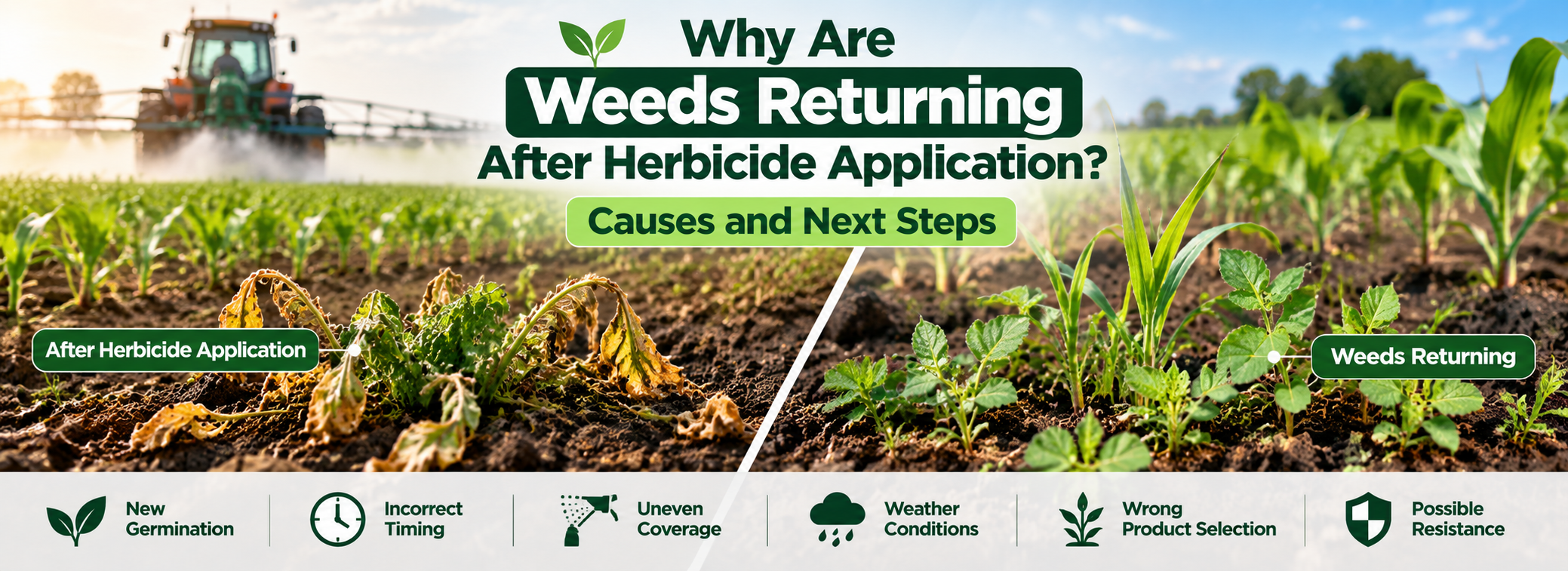
If you notice weeds returning after herbicide application, it does not always mean that the herbicide failed completely. In many fields, the weeds seen after treatment are actually a new flush of seedlings that germinated after the original weeds were controlled. In other situations, the same weeds may have survived because of application timing, incomplete spray coverage, unsuitable weather, incorrect weed identification or reduced herbicide effectiveness.
The first step is therefore to determine whether you are dealing with new weeds or surviving weeds.
This distinction matters because the next action may be completely different. New seedlings may indicate that the herbicide had limited residual activity or that the soil weed-seed bank produced another flush of germination. Surviving weeds, on the other hand, may indicate problems with spray timing, application technique, weed growth stage, product spectrum or environmental conditions.
Herbicide resistance is also possible, especially when the same weed species repeatedly survives correctly applied treatments. However, resistance should not be the first assumption. Farmers should first review the simpler and more common causes of poor weed control.
This guide explains why weeds return after herbicide application, how to identify the likely cause, what field signs to check, when herbicide resistance should be suspected and what to do before spraying again.
Quick Answer: Why Are Weeds Returning After Herbicide Application?
The most common reasons for weeds returning after herbicide application include:
- New weed seeds germinating after treatment
- Herbicide being applied at the wrong weed growth stage
- Uneven spray coverage
- Incorrect sprayer calibration
- Blocked or worn nozzles
- Rainfall or unfavorable weather around application
- Dry soil conditions affecting soil-applied herbicides
- Dense crop or weed canopy reducing spray contact
- The herbicide not controlling the weed species present
- Reduced herbicide activity because weeds were stressed
- Incorrect dose or application method
- Repeated use of the same herbicide mode of action
- Possible herbicide resistance
Before choosing another herbicide, identify the weed, inspect field patterns and review your application records.
Does Weed Regrowth Mean the Herbicide Failed?
Not necessarily.
One of the biggest mistakes in weed management is assuming that every weed appearing after herbicide application survived the original treatment.
There are two different situations:
1. Surviving weeds
These were already present when the herbicide was applied but were not fully controlled.
They may:
- Remain green after nearby weeds die
- Show partial injury and then resume growth
- Survive in specific strips or patches
- Be larger or more mature than newly emerged weeds
2. Newly germinated weeds
These emerged after the herbicide was applied.
They are usually:
- Smaller than the original weed population
- At a similar early growth stage
- Distributed in fresh patches
- Common after rainfall or irrigation
- Present after the earlier weeds were already controlled
Understanding this difference is essential before deciding whether another weed-control treatment is necessary.
Are These New Weeds or Surviving Weeds?
Before doing anything else, walk through the field and compare the current weeds with what was present before spraying.
A simple practical method is to mark a few weeds before treatment and return to the same locations several days later.
If the same weed plants remain alive or start growing again, they are likely survivors.
If the original weeds died but small new seedlings appeared later, the field is probably experiencing a new flush of germination.
How to Recognize Surviving Weeds
Surviving weeds often have:
- Larger roots
- More developed stems
- Older leaves
- Partial herbicide injury
- Yellowing or burned leaf edges followed by regrowth
- Multiple branches
- A size significantly larger than newly emerged seedlings
Sometimes only certain plants survive while neighboring weeds of the same species die.
That pattern deserves closer attention.
How to Recognize a New Flush of Weeds
A new flush commonly consists of:
- Small, young seedlings
- Weeds at a similar early growth stage
- Plants appearing after rainfall
- Plants emerging after irrigation
- Fresh seedlings appearing between previously controlled weeds
A new flush does not automatically mean that the original herbicide was ineffective.
Some post-emergence herbicides mainly control weeds present at the time of spraying and may provide little residual activity in the soil.
Why Weeds Return After Herbicide Application
Several factors can explain poor or incomplete weed control. Each should be reviewed systematically.
1. New Weed Seeds Germinated After the Spray
Agricultural soils contain large numbers of dormant weed seeds.
These seeds may remain in the soil and germinate when environmental conditions become favorable.
Rainfall, irrigation, soil disturbance and temperature changes can trigger new weed emergence.
If a herbicide controlled the weeds already present but did not provide long residual activity, another weed flush can appear later.
This is especially common where fields contain a large weed-seed bank.
What should you check?
Ask:
- Did the weeds present before spraying actually die?
- Did new weeds appear only after rainfall?
- Are the new weeds much smaller?
- Are they at a uniform seedling stage?
If yes, you may be dealing with new germination rather than treatment failure.
2. The Herbicide Was Applied Too Late
Herbicide timing is one of the most important factors affecting weed control.
Many post-emergence herbicides perform best when weeds are young and actively growing.
As weeds become larger, they may develop:
- Thicker leaves
- Larger root systems
- More branches
- Greater biomass
- More protective leaf surfaces
Large weeds can therefore be more difficult to control than seedlings.
If weeds were already advanced when spraying occurred, the treatment may suppress them without completely killing them.
Why weed stage matters
A product that performs well on small weeds may give weaker results when the same weed is older.
The correct growth stage depends on:
- Weed species
- Crop
- Herbicide
- Product label
- Growing conditions
There is no single ideal timing for every field.
3. The Herbicide Was Applied Too Early or at the Wrong Stage
Timing problems can also occur with pre-emergence herbicides.
Pre-emergence herbicides are designed to work around weed germination and early establishment.
Their performance may depend on:
- Soil moisture
- Correct application timing
- Soil condition
- Crop stage
- Rainfall or irrigation after application
If application timing does not match label instructions, weed control may be inconsistent.
The same applies to crop-specific restrictions.
Always follow the approved label for the crop and target weed.
4. Spray Coverage Was Uneven
Uneven herbicide coverage is a common reason for weed escapes.
Post-emergence herbicides often require good contact with actively growing weeds.
If weeds receive insufficient spray coverage, some plants may survive.
Possible causes include:
- Blocked nozzles
- Worn nozzles
- Uneven nozzle spacing
- Incorrect spray pressure
- Incorrect boom height
- Poor calibration
- Excessive tractor speed
- Spray drift
- Dense canopy
- Overlapping or missed strips
How Field Patterns Help Diagnose Coverage Problems
Look at how surviving weeds are distributed.
If escapes occur in straight strips or repeated patterns, this may indicate:
- A blocked nozzle
- Improper nozzle output
- Boom problems
- Missed passes
- Poor overlap between spray runs
Random weed survival throughout the field may suggest a different cause.
Field patterns can provide important clues before another herbicide is considered.
5. Sprayer Calibration Was Incorrect
Correct herbicide application depends on accurate spray equipment calibration.
A poorly calibrated sprayer may deliver:
- Too little spray solution
- Too much spray solution
- Uneven herbicide distribution
Calibration should consider:
- Travel speed
- Nozzle flow
- Working pressure
- Boom width
- Spray volume
- Product dose
- Tank volume
Incorrect calibration can produce inconsistent weed control even when the correct herbicide is selected.
6. Nozzles Were Blocked, Worn or Incorrect
Spray nozzles directly affect droplet size, spray distribution and coverage.
A blocked nozzle may leave an untreated strip.
A worn nozzle may deliver more liquid than expected.
Incorrect nozzle selection may create unsuitable spray droplets.
Before spraying again:
- Check nozzle condition
- Clean blocked nozzles properly
- Replace damaged or worn components
- Confirm spray pattern
- Verify output across the boom
Equipment inspection should be part of every herbicide troubleshooting process.
7. Dense Crop or Weed Canopy Reduced Coverage
Dense vegetation can prevent spray droplets from reaching smaller weeds underneath.
For example, a tall weed canopy may intercept much of the spray.
Smaller weeds below the canopy may receive insufficient herbicide.
This is another reason why early-stage weed control is generally easier than controlling large, dense weed populations.
Inspect different canopy levels when reviewing a field.
8. Rainfall Affected Herbicide Performance
Weather around application can strongly influence herbicide performance.
For some foliar herbicides, rainfall shortly after application may wash some product from the leaf surface before adequate absorption occurs.
However, the actual rain-free period varies by product.
Always check the product label rather than assuming one universal rule.
Ask yourself:
- Did it rain shortly after application?
- How long after spraying did rainfall begin?
- What does the product label say about rainfastness?
- Was the crop or weed already wet at application?
Keep weather records whenever possible.
9. Soil-Applied Herbicide Was Not Properly Activated
Some pre-emergence or residual herbicides need moisture in the soil profile to work effectively.
If the soil is too dry, the herbicide may remain near the surface without becoming adequately available in the weed-germination zone.
New weeds may then emerge.
Conversely, very heavy rainfall may sometimes move herbicide within the soil profile, depending on the active ingredient, soil type and label conditions.
Soil-applied herbicide performance can be influenced by:
- Soil moisture
- Rainfall
- Irrigation
- Soil texture
- Organic matter
- Application timing
10. Weeds Were Under Environmental Stress
Post-emergence herbicides often perform better when target weeds are actively growing.
Stress conditions may slow plant metabolism and reduce herbicide uptake or movement.
Stress can result from:
- Drought
- Extreme heat
- Cold conditions
- Waterlogging
- Nutrient stress
- Crop competition
If weeds were severely stressed at application, treatment performance may differ from applications made under active growth conditions.
11. The Herbicide Does Not Control the Weed Species Present
Not every herbicide controls every weed.
A field may contain:
- Grasses
- Broadleaf weeds
- Sedges
- Mixed weed populations
Some herbicides control mainly grasses.
Others target broadleaf weeds.
Others may be more specific.
This is why weed identification should occur before product selection.
If one weed species survives while several others die, check whether the surviving species is included in the product’s approved control spectrum.
Identify the Weed Before Assuming Herbicide Failure
Record:
- Weed species
- Leaf shape
- Growth habit
- Stem characteristics
- Flower or seed-head structure
- Location within the field
Take clear photographs if you are uncertain.
A qualified agronomist or agricultural adviser can help identify the species.
12. The Product Was Not Suitable for the Crop or Application Stage
Herbicides are approved for specific uses.
A product may be appropriate for one crop but not another.
Similarly, crop growth stage may determine whether an application is permitted.
Always verify:
- Crop
- Weed species
- Application timing
- Crop stage
- Dose
- Method
- Waiting period
- Label restrictions
Do not select a herbicide only because it controlled weeds in another crop or neighboring field.
13. Incorrect Dose or Mixing May Have Reduced Performance
Incorrect herbicide concentration can affect performance.
Common mistakes include:
- Miscalculating field area
- Using incorrect water volume
- Measuring product inaccurately
- Poor tank mixing
- Incorrect mixing order
- Inadequate agitation
Never respond to poor control by automatically increasing the dose.
Higher-than-approved rates can create crop injury, residue concerns or other problems.
Always stay within the approved label instructions.
14. Dust or Mud on Weed Leaves Reduced Contact
Heavy dust on leaves may reduce contact between spray droplets and the weed surface.
Similarly, weeds covered with soil or mud may not receive ideal spray coverage.
This can happen near field roads, dry cultivation areas or after certain field operations.
Check the physical condition of weeds before spraying.
15. Herbicide Was Applied to Mature Weeds
Older weeds can be much harder to control.
Once weeds become mature, they may:
- Develop deeper roots
- Produce woody stems
- Begin flowering
- Set seed
- Become less responsive to certain treatments
Even if the top growth is damaged, some perennial weeds may regenerate from roots, rhizomes, tubers or other underground structures.
Weed biology therefore matters as much as spray timing.
Could Herbicide Resistance Be the Reason?
Yes, but resistance should be investigated carefully.
Herbicide resistance means that a weed population has developed the ability to survive a herbicide dose that previously controlled susceptible plants when the product was correctly used.
Resistance is more likely when:
- The same weed species repeatedly survives
- Nearby weeds of other species are controlled
- Applications were correctly timed
- Equipment was properly calibrated
- Coverage was adequate
- Weather was suitable
- Correct label dose was used
- The same herbicide mode of action has been used repeatedly
What Does Herbicide Resistance Look Like in a Field?
Possible field clues include:
- Living weeds surrounded by dead weeds of the same species
- Similar survivors appearing year after year
- A particular species becoming increasingly dominant
- Reduced control despite correct application
- Survival following repeated use of the same herbicide group
However, these signs are not proof on their own.
Poor application can create similar patterns.
Do Not Assume Resistance Immediately
Before concluding that resistance exists, review:
- Weed identification
- Weed stage
- Application timing
- Product label
- Dose
- Sprayer calibration
- Nozzle condition
- Weather
- Rainfall
- Soil condition
- Previous herbicide history
A local agronomist can help determine whether resistance testing or a different weed-management strategy is appropriate.
Why Repeating the Same Herbicide Can Increase Risk
Using the same herbicide mode of action repeatedly can create selection pressure.
Susceptible weeds are controlled while naturally less-sensitive individuals survive and reproduce.
Over several seasons, the proportion of resistant weeds may increase.
This is one reason integrated weed management is important.
A long-term programme may combine:
- Herbicide rotation
- Different modes of action
- Mechanical weed control
- Crop rotation
- Competitive crop establishment
- Clean seed
- Field sanitation
- Prevention of weed seed production
The correct approach depends on the crop and local agronomic conditions.
What Should You Do Before Spraying Again?
When weeds are returning after herbicide application, do not automatically repeat the same treatment.
Use the following checklist.
Step 1: Identify the Weed
Determine exactly which weed species survived or emerged.
Take photos of:
- Whole weed
- Leaves
- Stem
- Roots
- Flowers
- Seed heads
Accurate identification is the foundation of weed control.
Step 2: Determine Whether It Is New Growth
Compare the size of current weeds with plants that were present during the first spray.
If weeds are much smaller, they may have germinated later.
Step 3: Inspect Multiple Field Areas
Do not judge performance from one section.
Walk:
- Field edges
- Center
- Low areas
- High areas
- Spray entry points
- Areas where overlaps occurred
This helps identify whether the problem is uniform or patterned.
Step 4: Check the Application Date
Review:
- Date of application
- Crop stage
- Weed stage
- Time of day
- Recent rainfall
- Irrigation schedule
Step 5: Review Weather Records
Check:
- Rain after spraying
- Temperature
- Wind
- Humidity
- Drought stress
- Soil moisture
Weather may explain unexpected performance.
Step 6: Inspect the Sprayer
Check:
- Nozzles
- Filters
- Pump pressure
- Boom height
- Spray pattern
- Calibration
- Tank agitation
Correct equipment problems before another application.
Step 7: Review the Herbicide Label
Confirm:
- Crop approval
- Target weed
- Weed size
- Application stage
- Dose
- Water volume
- Rainfast period
- Reapplication restrictions
- Maximum seasonal applications
Step 8: Check Herbicide History
Record which herbicides were used:
- This season
- Last season
- During previous crop rotations
Repeated use of the same mode of action may influence long-term resistance risk.
Step 9: Consult a Local Expert
If the reason for poor control is unclear, contact:
- Qualified agronomist
- Agricultural extension officer
- Krishi Vigyan Kendra
- Weed specialist
- Crop protection adviser
Local conditions can strongly influence management decisions.
Should You Spray the Same Herbicide Again?
Not automatically.
Repeating the same herbicide without understanding why the first application underperformed can lead to:
- Continued poor control
- Crop injury
- Unnecessary expense
- Increased selection pressure
- Additional residues
- Delayed weed management
Any follow-up treatment should be:
- Approved for the crop
- Suitable for the weed
- Permitted at the current crop stage
- Used according to the label
If repeated herbicide use is not appropriate, mechanical or cultural control may be considered.
Can Mechanical Weeding Help?
Yes, depending on the crop, field condition and weed stage.
Mechanical control may include:
- Hand weeding
- Hoeing
- Inter-row cultivation
- Weed cutting
- Shallow cultivation
Mechanical methods can be especially useful when surviving weeds are scattered.
However, care must be taken to avoid crop damage.
Perennial weeds may also regrow from underground structures if only the shoots are removed.
How Integrated Weed Management Can Reduce Repeat Weed Problems
Integrated Weed Management, or IWM, combines multiple strategies rather than depending on one herbicide.
A practical programme may include:
- Timely herbicide application
- Weed identification
- Crop rotation
- Crop competition
- Mulching where applicable
- Mechanical control
- Clean planting material
- Preventing seed production
- Rotating herbicide modes of action
- Monitoring field escapes
The goal is to reduce weed pressure over time.
Prevent Weeds From Producing Seed
One surviving weed may produce many seeds.
If resistant or difficult-to-control weeds set seed, they can increase future weed pressure.
Where practical and locally recommended, remove isolated escapes before seed production.
How Crop Rotation Helps Weed Management
Crop rotation changes the production environment.
Different crops may allow:
- Different sowing periods
- Different cultivation practices
- Different crop competition
- Different herbicide options
- Different weed-control timings
This can disrupt weed populations that have adapted to one continuous cropping system.
Crop rotation should therefore be considered part of long-term weed management rather than only as a soil-management practice.
Pre-Emergence vs Post-Emergence Herbicides
Understanding the difference can help explain why weeds reappear.
Pre-Emergence Herbicides
These are typically used around the period of weed germination.
Their performance may depend on:
- Soil moisture
- Application timing
- Herbicide placement
- Soil properties
They may offer residual weed suppression for a certain period.
However, residual activity does not continue indefinitely.
Post-Emergence Herbicides
These are applied to weeds that have already emerged.
They may have limited or no activity on seeds that germinate later.
Therefore, a fresh weed flush can appear even after excellent control of the first population.
How Rainfall Can Create a New Weed Flush
Rainfall can trigger weed seed germination.
A field that looks clean after spraying may develop many small weeds after rain.
This can sometimes be misinterpreted as herbicide failure.
Check whether:
- Original weeds were controlled
- New weeds appeared after rain
- New plants are much smaller
- Emergence is relatively uniform
If so, the new population likely germinated after the application.
Weed Escape Patterns and What They May Mean
Field patterns are useful diagnostic tools.
Straight strips of weeds
Possible cause:
- Blocked nozzle
- Missed spray pass
- Uneven boom output
Weeds mainly at field edges
Possible cause:
- Different spray coverage
- New seed entry
- Border vegetation
- Equipment turning patterns
One weed species surviving throughout the field
Possible causes:
- Herbicide does not control that weed
- Wrong weed growth stage
- Resistance
- Biological tolerance
Small weeds emerging everywhere later
Possible cause:
- New germination
Random patches of large survivors
Possible causes:
- Uneven coverage
- Variable weed stage
- Dense canopy
- Application problems
Common Mistakes to Avoid
Do Not Increase the Dose Without Guidance
Using more herbicide does not automatically improve control.
It may:
- Injure the crop
- Increase residue risk
- Increase environmental exposure
- Violate the product label
Do Not Mix Products Randomly
Tank mixes should only be used where approved and compatible.
Incorrect mixtures may result in:
- Crop injury
- Reduced efficacy
- Physical incompatibility
- Nozzle blockage
Do Not Spray Unknown Weeds
Identify the weed before choosing the product.
Do Not Ignore Application Records
Good records help diagnose failures.
Maintain:
- Product name
- Active ingredient
- Dose
- Date
- Field
- Weed stage
- Weather
- Water volume
- Nozzle type
- Crop stage
Field Checklist for Weeds Returning After Herbicide Application
Use this simple checklist:
Weed identification
What species is present?
Weed age
Are these new seedlings or old plants?
Crop stage
What growth stage is the crop in?
Herbicide timing
When was the treatment applied?
Weed stage at application
Were weeds young or mature?
Coverage
Did all weeds receive adequate spray?
Equipment
Were the nozzles functioning correctly?
Weather
Was there rainfall, drought or extreme temperature?
Soil condition
Was the soil dry, wet or waterlogged?
Product spectrum
Does the herbicide control this weed?
Previous history
Has the same herbicide been used repeatedly?
Resistance
Does the same species repeatedly survive correct applications?
Frequently Asked Questions
Why are weeds returning after herbicide application?
Weeds may return because new seeds germinated after treatment, weeds were too large at spraying, spray coverage was incomplete, weather affected herbicide activity or the product did not control the weed species present. Herbicide resistance is also possible but should be investigated after ruling out application-related causes.
Does weed regrowth mean the herbicide failed?
No.
Some weeds may be newly germinated plants that emerged after the original population was controlled.
Compare weed size and field location before assuming treatment failure.
How do I know if weeds survived the herbicide?
Mark existing weeds before spraying and inspect them later.
Surviving weeds will usually be larger and show partial injury or regrowth.
New seedlings will generally be smaller and at an earlier growth stage.
Why did some weeds die while others survived?
Possible reasons include:
- Different weed species
- Different growth stages
- Uneven spray coverage
- Different weed susceptibility
- Herbicide resistance
- Canopy interference
Can rain reduce herbicide performance?
Yes, depending on the herbicide.
Some post-emergence products require a rain-free period for absorption.
Check the specific product label.
Can rain also cause more weeds to appear?
Yes.
Rain can trigger germination of weed seeds already present in the soil.
This may create a new flush even after the first weeds were controlled.
Why are weeds appearing after a pre-emergence herbicide?
Residual herbicide activity may decline over time.
Dry soil, incorrect timing, soil properties and later weed germination can also affect performance.
Should I spray again if weeds return?
Do not automatically spray again.
First identify whether the weeds are new seedlings or survivors and determine why the previous treatment did not provide sufficient control.
Should I use a stronger herbicide?
Not simply because weeds returned.
The next product should be selected according to:
- Crop
- Weed
- Crop stage
- Approved label
- Previous herbicide history
Can herbicide resistance cause weeds to survive?
Yes.
Resistance should be considered when the same weed species repeatedly survives correctly applied herbicides, especially after repeated use of the same mode of action.
How can I prevent herbicide resistance?
A long-term strategy may include:
- Rotating modes of action
- Crop rotation
- Mechanical weed control
- Preventing seed production
- Correct timing
- Accurate herbicide use
Is hand weeding useful after herbicide failure?
It can be useful where weed escapes are scattered and manual removal is practical.
The appropriate method depends on crop type, field condition and weed biology.
Final Takeaway
When you see weeds returning after herbicide application, do not immediately assume that the herbicide failed.
First determine whether the weeds are:
- Surviving plants from the original infestation
- Newly germinated seedlings
Then investigate the likely cause.
Check:
- Weed species
- Weed growth stage
- Crop stage
- Application timing
- Spray coverage
- Sprayer calibration
- Nozzle condition
- Rainfall
- Soil moisture
- Weather
- Product spectrum
- Herbicide history
If survivors continue to appear despite correct product selection and application, herbicide resistance may need further investigation.
The best next step should be based on field evidence rather than simply repeating the same treatment.
A well-planned weed-management programme combines accurate weed identification, correct herbicide use, monitoring, crop rotation, mechanical control where practical and prevention of weed seed production.
Need Help Reviewing a Weed Control Problem?
If you are dealing with weeds returning after herbicide application, share your field information with AGRIVO Chemicals Private Limited.
To help evaluate the situation, provide:
- Crop name
- Crop growth stage
- Clear weed photographs
- Weed species, if known
- Herbicide previously applied
- Application date
- Weed stage at application
- Dose used
- Rainfall or irrigation after application
- Current condition of surviving weeds
AGRIVO’s team can help you enquire about suitable crop protection options and relevant product-label guidance.
AGRIVO Chemicals Private Limited
Call: +91 97635 55529
Email: info@agrivochemicals.com
Website: agrivochemicals.com
Always use herbicides strictly according to the approved label, crop registration, recommended dose, application stage, safety requirements and local agricultural guidance.