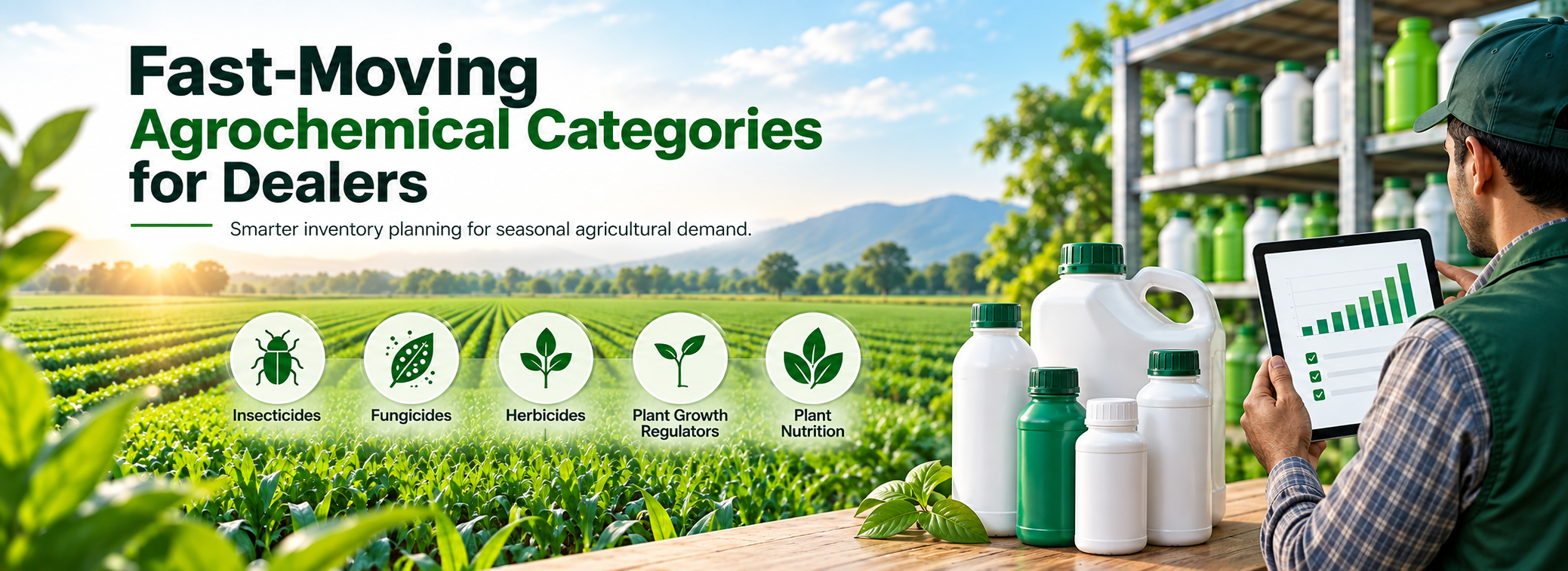
Understanding fast-moving agrochemical categories helps agricultural dealers maintain relevant inventory, respond quickly to farmers’ needs and reduce the risk of overstocking unsuitable products. Insecticides, fungicides, herbicides, Plant Growth Regulators and plant-nutrition products commonly generate seasonal demand, but their movement depends on local crops, weather, pest pressure and agricultural practices.
Dealers should therefore combine product knowledge with local market data instead of purchasing stock only because a category is popular elsewhere.
Why Dealers Must Understand Fast-Moving Agrochemical Categories
Agricultural demand can change rapidly. A sudden pest outbreak, extended humidity, delayed rainfall or weed flush can increase demand for specific products within days.
Knowledge of agrochemical products for dealers supports:
- Better seasonal inventory planning
- Faster response to farmers’ requirements
- Lower risk of expired or slow-moving stock
- More responsible product recommendations
- Stronger relationships with farmers and distributors
- Improved repeat business
Agrivo Chemicals’ portfolio covers insecticides, fungicides, herbicides and Plant Growth Regulators, along with broader crop-protection and plant-health solutions. Agrivo Chemicals
Key Fast-Moving Agrochemical Categories for Dealers
1. Insecticides for Major Crop Pests
Insecticides are frequently required when crops face sucking pests, chewing insects, borers or caterpillars. Demand may increase sharply when farmers observe leaf curling, holes, sticky leaves, damaged flowers or affected fruits.
Dealers should understand:
- Target pest mentioned on the label
- Approved crop and application stage
- Contact, systemic or translaminar action
- Formulation and application method
- Mode-of-action group
- Safety and waiting-period instructions
Avoid recommending one insecticide for every insect problem. Correct pest identification is essential for reliable control.
2. Fungicides for Preventive and Curative Crop Care
Fungicide demand often rises during humid, cloudy or rainy conditions when crops become more vulnerable to fungal diseases. Farmers may seek help for leaf spots, blights, mildew, rotting or wilting.
Agricultural dealers should know the difference between:
- Preventive and curative fungicides
- Contact and systemic fungicides
- Seed-treatment and foliar products
- Single-active and combination products
Early disease identification can improve treatment decisions. Severe symptoms may require expert diagnosis rather than an immediate product sale.
3. Herbicides for Seasonal Weed Management
Herbicides can become fast-moving products during land preparation and early crop-growth stages. Demand differs according to the crop, weed species and application timing.
Important herbicide groups include:
- Pre-plant herbicides
- Pre-emergence herbicides
- Post-emergence herbicides
- Selective herbicides
- Non-selective herbicides
Dealers must never suggest a herbicide without confirming the crop, target weed and growth stage. Using the wrong product can damage the crop or provide poor weed control.
4. Plant Growth Regulators for Crop Development
Plant Growth Regulators, or PGRs, attract demand when farmers want to manage plant growth, flowering, fruit setting or crop development. However, PGRs are not substitutes for balanced nutrition, irrigation or pest management.
Before recommending a PGR, dealers should understand:
- Its specific function
- Suitable crop and growth stage
- Approved concentration
- Correct application timing
- Compatibility with other inputs
- Risks of excessive or incorrect application
Responsible guidance can help prevent unrealistic expectations and improper use.
5. Plant-Nutrition and Water-Soluble Fertilizer Products
Plant-nutrition products may move throughout the growing cycle because crop requirements change from vegetative growth to flowering and fruit development.
Common areas of farmer demand include:
- Water-soluble NPK fertilizers
- Secondary nutrients
- Micronutrients
- Foliar nutrition
- Crop-stage-specific formulations
Visible symptoms alone may not confirm a nutrient deficiency. Soil, water or leaf analysis can support better recommendations, especially when symptoms resemble disease or environmental stress.
6. Biologicals and Specialised Crop-Care Products
Demand for biological crop-care products is growing among farmers using Integrated Pest Management and residue-conscious production systems. Dealers may also receive requirements for rodenticides and other specialised products used on farms or in storage areas.
These products require proper handling, storage and explanation. Their performance should be communicated realistically and according to the approved label.
How Dealers Can Plan Agricultural Input Inventory
Match Agrochemical Stock With Local Demand
Use the following information before placing bulk orders:
- Major crops grown in the sales territory
- Crop calendars and sowing periods
- Frequently reported pests, diseases and weeds
- Weather forecasts and seasonal conditions
- Previous years’ sales records
- Current stock and expiry dates
- Farmer and retailer enquiries
- Supplier lead times
Maintain deeper stock of proven, regularly demanded products and limited quantities of highly seasonal items. Use a first-expiry, first-out system and review inventory frequently during peak periods.
What Dealers Should Check Before Stocking Agrochemicals
Verify that every product has:
- Proper registration and approved labelling
- Intact and sealed packaging
- Clear batch and expiry information
- Appropriate storage requirements
- Reliable manufacturer or distributor support
- Demand relevant to local crops
- Sufficient remaining shelf life
Never sell expired, leaking, unlabelled or damaged products. Store agrochemicals securely, away from food, animal feed, sunlight and unauthorised access.
Frequently Asked Questions
Which agrochemical category sells the fastest?
There is no universal fastest-selling category. Demand depends on local crops, weather, pest outbreaks and the crop-growth stage.
How can dealers avoid overstocking agrochemicals?
Use historical sales, crop calendars, current enquiries and weather patterns. Purchase seasonal products in planned quantities and regularly monitor expiry dates.
Should dealers stock several brands with the same active ingredient?
Stock decisions should consider farmer demand, product quality, formulation, mode of action and shelf movement. Too many similar products can unnecessarily lock up working capital.
Can dealers recommend products based only on crop symptoms?
No. Similar symptoms can result from pests, diseases, nutrient deficiencies or weather stress. Encourage proper diagnosis and qualified agricultural guidance when uncertain.
Why is mode-of-action knowledge important?
It helps dealers guide farmers towards responsible product rotation and reduce repeated dependence on the same chemical group.
Build a Smarter Agrochemical Dealership With Agrivo Chemicals
Understanding fast-moving agrochemical categories enables dealers to stock more intelligently, support farmers responsibly and build a sustainable agricultural input business.
Looking for dependable crop-protection products, dealership opportunities or bulk product information? Connect with Agrivo Chemicals Private Limited today.
📞 Call: +91 97635 55529
📧 Email: info@agrivochemicals.com
🌐 Visit: www.agrivochemicals.com
Product demand and recommendations vary by crop, region and season. Always follow approved labels, registration requirements and qualified agricultural guidance.