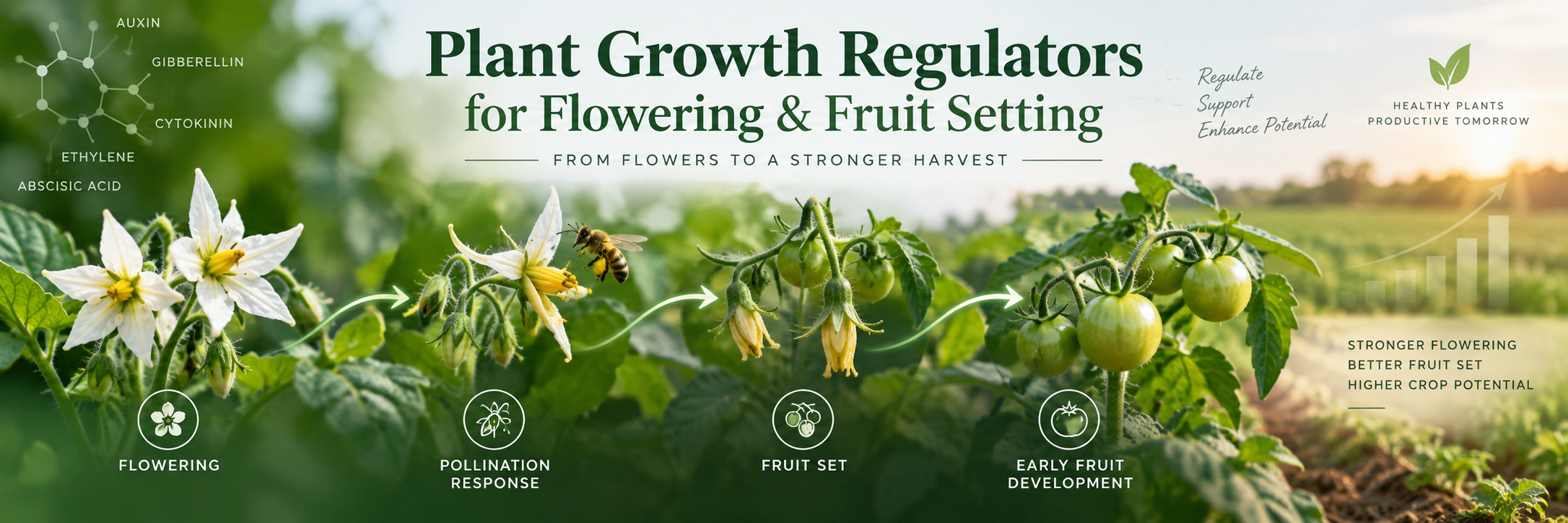
Yes. Plant growth regulators for flowering and fruit setting can support important reproductive processes in crops when the right PGR is used at the correct growth stage and according to crop-specific recommendations.
Plant Growth Regulators, commonly known as PGRs, influence natural physiological processes such as flower-bud development, flowering, fruit formation, fruit retention and fruit growth.
However, PGRs should not be considered a shortcut to higher yield. Successful flowering and fruit setting also depend on plant nutrition, irrigation, pollination, crop health, weather conditions, pest management and the correct application method.
The effectiveness of a PGR for flowering or fruit setting can vary considerably between crops, varieties and growth stages. Correct product selection, dose and timing are therefore essential.
What Are Plant Growth Regulators?
Plant Growth Regulators are substances that influence or regulate specific physiological processes within a plant.
Plants naturally produce hormones that control growth and development. Agricultural PGR formulations are used to influence selected plant responses for specific crop-management objectives.
Depending on the active ingredient and crop, PGRs may influence cell division and elongation, root and shoot development, flower-bud formation, flowering, fruit setting, fruit retention, fruit growth, maturity and the plant’s response to certain environmental conditions.
In agriculture, the objective is not simply to make a plant grow faster. Instead, PGRs are used strategically to manage a particular stage of crop development.
How Do Plant Growth Regulators Help Flowering?
A properly selected PGR for flowering may support the transition from vegetative growth to reproductive development.
Flowering is a complex process influenced by genetics, temperature, light, water availability, nutrient balance and internal plant hormones. For this reason, PGR application should form part of an overall crop-management programme rather than being used independently.
Supporting Flower-Bud Development
Flower formation begins before flowers become visible.
During flower-bud initiation and development, the plant begins allocating resources towards reproductive growth. Depending on the crop and formulation, an appropriate PGR programme may help support flower-bud development and reproductive activity.
Correct timing is especially important because applying a PGR too early, too late or at an unsuitable concentration can produce a different response from the one intended.
Promoting More Uniform Flowering
Irregular flowering can lead to uneven fruit development and multiple harvesting periods.
In selected crops, appropriate growth-regulator programmes may help improve flowering uniformity. More synchronized flowering can make activities such as crop monitoring, nutrient management and harvesting easier to plan.
However, the response will depend on the crop, variety and environmental conditions.
Managing Flowering During Sensitive Growth Stages
Flowering is one of the most sensitive stages in the crop cycle.
High temperatures, water stress, nutrient imbalance, unsuitable weather, pests and diseases may negatively affect flower development and retention.
A suitable PGR programme may support plant development during reproductive stages, but it cannot correct severe irrigation problems, nutrient deficiencies, poor pollination or uncontrolled pest and disease pressure.
Can PGRs Increase Fruit Setting?
A PGR for fruit setting can influence physiological processes associated with the period between flowering and early fruit development.
Fruit set occurs when flowers successfully progress into developing fruits. This process depends on several interconnected factors, including flower health, pollination, fertilisation, nutrient availability, irrigation, temperature, humidity and plant hormonal activity.
Depending on the crop and active ingredient, PGRs may support flower retention, early fruit development, cell division, cell expansion and fruit growth.
Some crop-specific PGR programmes may also help manage premature flower or young-fruit drop.
However, PGR response varies significantly between crops. A growth regulator, dose or application stage that works for one crop may not produce the same result in another.
How Do Plant Hormones Affect Flowering and Fruit Development?
Different plant growth hormones perform different functions during crop growth and reproductive development.
| Plant Hormone | Main Role in Plant Development |
|---|---|
| Auxins | Associated with cell growth, rooting, fruit formation and the regulation of fruit retention or drop in certain crops. |
| Gibberellins | Influence cell elongation, growth, flowering and fruit development. Their effects depend strongly on crop, timing and concentration. |
| Cytokinins | Primarily associated with cell division, bud activity and the development of growing plant tissues and fruits. |
| Ethylene | Involved in processes such as flowering responses in certain crops, fruit ripening, maturity, senescence and abscission. |
| Abscisic Acid | Plays an important role in plant responses to water stress, dormancy and several developmental processes. |
These hormones interact with one another inside the plant. This is one reason why agricultural PGR application must be based on the specific crop objective rather than a general assumption that one product can increase flowering or fruit setting in every crop.
What Causes Poor Flowering or Fruit Setting?
Before using a PGR, growers should identify why flowering or fruit setting is below expectations.
Poor reproductive performance may be associated with nutrient imbalance, water stress, high or low temperatures, weak plant growth, excessive vegetative growth, inadequate pollination, pest attack, disease pressure, inappropriate pruning, unsuitable crop load or incorrect agricultural practices.
For example, applying a PGR will not solve poor fruit set caused primarily by inadequate pollination.
Similarly, a plant suffering from severe moisture or nutritional stress may respond differently from a healthy, actively growing plant.
Identifying the actual limiting factor is therefore an important step before deciding whether a PGR is appropriate.
Factors That Affect PGR Performance
The performance of plant growth regulators for flowering and fruit setting depends on several variables.
Crop and variety influence the physiological response. The application must also match the recommended growth stage, concentration, spray volume and method.
Plant health is equally important. Plants with active leaves, adequate nutrition and proper irrigation generally provide a more suitable foundation for crop-management programmes than severely stressed plants.
Weather at the time of application can also influence performance. Temperature, humidity, rainfall and wind may affect spray deposition, absorption and overall plant response.
Proper coverage and correctly calibrated spraying equipment are therefore important.
Most importantly, increasing the PGR dose beyond recommendations does not automatically increase flowering or fruit setting. Excessive concentration or incorrect timing may instead result in undesirable plant responses.
PGRs vs Fertilizers: What Is the Difference?
Plant growth regulators and fertilizers perform different functions.
| PGRs | Fertilizers |
|---|---|
| Influence physiological processes within plants | Supply essential plant nutrients |
| May regulate growth, flowering or fruit development | Support plant nutrition and metabolic requirements |
| Usually applied for a specific crop-development objective | Applied to correct or maintain nutritional requirements |
| Effect depends strongly on crop stage and timing | Requirement depends on crop nutrient demand and soil or plant status |
A PGR cannot replace the nutrients required for plant growth.
Likewise, applying additional fertilizer does not perform the same physiological function as a crop-specific plant growth regulator.
The two may form part of the same crop-management programme, but each serves a different purpose.
Best Practices for Using PGRs for Flowering and Fruit Setting
For more reliable PGR performance:
- Clearly identify whether the objective is flower initiation, flowering uniformity, fruit setting, fruit retention or fruit development. Confirm that the selected PGR is recommended and registered for the intended crop and use. Follow the product label for concentration, dose, spray volume and application stage. Avoid arbitrary increases in dosage. Apply under suitable weather conditions and avoid strong wind, intense heat or expected rainfall where the label advises against application. Use clean water and properly calibrated spraying equipment. Check compatibility before combining PGRs with fertilizers, pesticides or other products. Maintain appropriate irrigation, plant nutrition and crop-protection practices. Keep records of product, dose, date, growth stage, weather and crop response. Consult a qualified agricultural professional when crop-specific guidance is required.
Can PGRs Help Reduce Flower Drop?
Certain plant growth regulators may help manage premature flower or fruit drop in specific crops when the underlying physiological condition is suitable for PGR intervention.
However, flower drop can have many causes.
High temperature, water stress, nutrient imbalance, weak pollination, pests, diseases and other environmental factors may all contribute.
Therefore, growers should first determine the probable cause of flower drop before selecting a product.
Using a PGR to reduce flower drop without identifying the underlying problem may not produce the desired result.
When Should PGRs Be Applied for Flowering?
There is no universal application stage for every plant growth regulator.
Depending on the crop and formulation, applications may be recommended during flower-bud development, before flowering, during flowering, immediately after flowering or during early fruit development.
Timing is particularly important because plants respond differently to growth regulators at different physiological stages.
Always follow the registered product label and crop-specific recommendations rather than applying a product solely because flowering has started.
How Can Farmers Improve Flowering and Fruit Setting?
PGRs work best when supported by good agronomic practices.
Healthy reproductive growth normally requires adequate water management, balanced crop nutrition, proper pest and disease control, healthy foliage, effective pollination where required and suitable environmental conditions.
For commercial crops, monitoring the crop before flowering can also help identify issues early enough to take corrective action.
Rather than depending on a single input, growers should view flowering and fruit setting as the result of the complete crop-management programme.
Frequently Asked Questions
Do plant growth regulators guarantee more flowers and fruits?
No. Plant growth regulators can support specific physiological processes related to flowering and fruit setting, but they cannot guarantee increased flowering, fruit number or yield. Results depend on the crop, variety, plant health, weather, pollination, nutrition, irrigation, product selection, dose and timing.
Which PGR is best for flowering?
There is no single PGR that is best for flowering in every crop. Different crops respond differently to auxins, gibberellins, cytokinins, ethylene-related products and other growth regulators. Product selection should be based on the crop, growth stage and intended objective.
Can PGRs increase fruit setting?
Certain PGRs can support fruit-setting processes in selected crops when used according to crop-specific recommendations. Successful fruit set also requires healthy flowers, suitable pollination or fertilisation where relevant, proper nutrition, irrigation and favourable growing conditions.
Can PGRs reduce flower and fruit drop?
Specific plant growth regulators may help manage premature flower or fruit drop in certain crops. However, the actual cause of the drop should first be identified because environmental stress, nutrition, irrigation, pests, diseases or pollination problems may also be responsible.
When should PGRs be applied for fruit setting?
Application timing varies according to crop and product. Some treatments may be recommended during flowering, while others are intended for post-flowering or early fruit-development stages. Always follow the approved label.
Are PGRs the same as fertilizers?
No. Fertilizers provide nutrients required for plant growth, while plant growth regulators influence physiological processes. A PGR should not be used as a replacement for proper crop nutrition.
Can PGRs be mixed with fertilizers or pesticides?
Compatibility depends on the formulation and products involved. Farmers should follow product-label recommendations and verify physical and chemical compatibility before preparing a tank mixture.
Does using more PGR give better results?
No. Increasing the concentration beyond the recommended dose does not guarantee better results and may cause undesirable crop responses. Correct concentration and application timing are important for effective PGR use.
Conclusion
Plant growth regulators for flowering and fruit setting can be valuable tools for managing reproductive crop development when they are selected and applied correctly.
Depending on the crop and formulation, PGRs may support flower-bud development, flowering uniformity, fruit setting, fruit retention and early fruit development.
Their effectiveness, however, depends on much more than the product itself.
Crop variety, growth stage, dose, timing, nutrition, irrigation, pollination, plant health, weather conditions and overall crop management all influence the final response.
For this reason, PGRs should be used as part of an integrated crop-management programme and always according to the registered product label and crop-specific recommendations.
Looking for Crop Growth and Agricultural Solutions?
Agrivo Chemicals Private Limited provides agricultural crop-care solutions for farmers, distributors and agricultural businesses.
For product information, crop-specific recommendations or distributor enquiries, connect with the Agrivo Chemicals team.
Call: +91 97635 55529
Email: info@agrivochemicals.com
Website: agrivochemicals.com